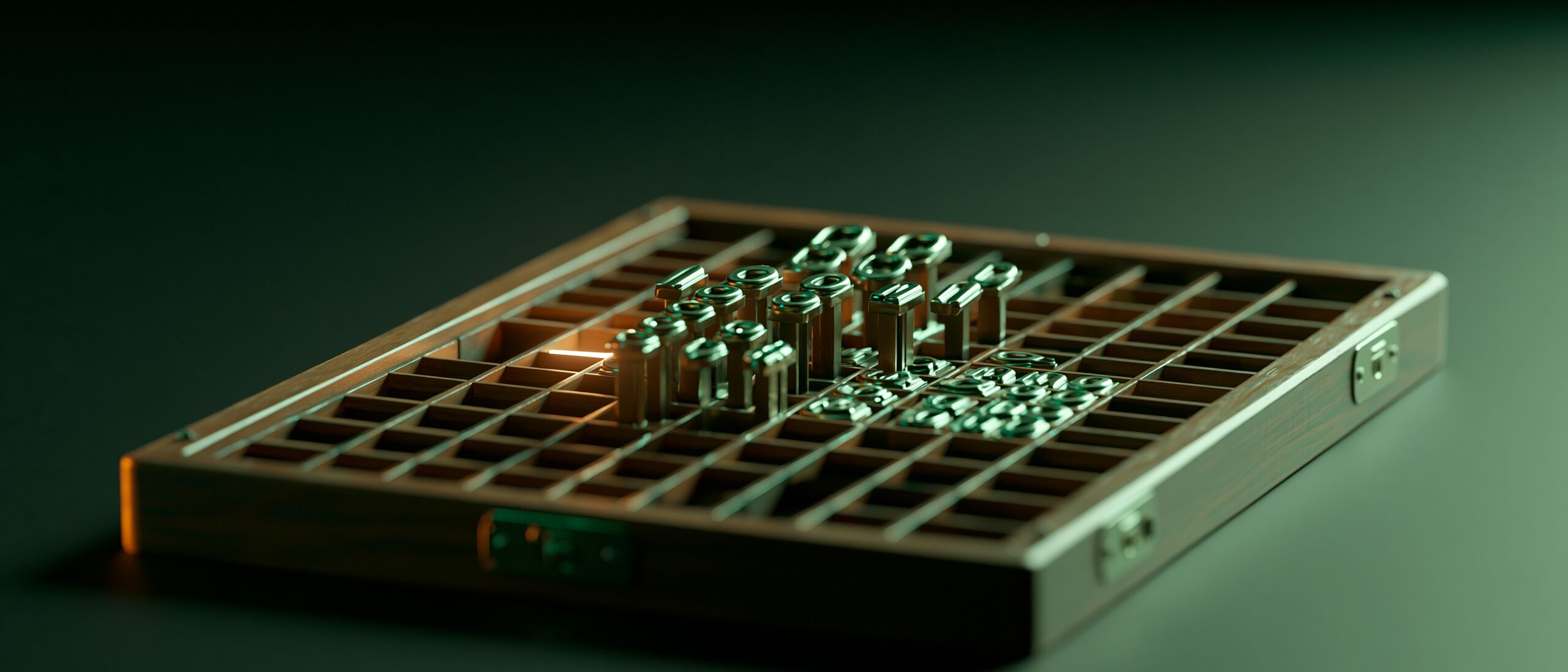
Primitives
How many different things does mathematics actually do? A vocabulary of about seventy structural operations, derived from school mathematics, tested on 110 formulas, formalised as a small category, and then measured until it stopped promising more than it delivered.
- The question
- Is there a small, defensible set of structural primitives such that any formula in the lab's corpus decomposes into them, and can a search phrased in those primitives find structural twins across fields that a search by topic misses?
- The verdict
- The vocabulary holds as a description: 97.3 percent of 110 formulas decompose into it, and it is formalised well enough to reason about. As a discovery engine it fails: everything it found was textbook knowledge, and the yield fell as the fields grew further apart. It stands as a structural index and sleeps until the formula corpus is re-extracted.
The question
Textbooks in physics, finance, ecology and control theory keep writing the same shapes of formula under different names. The lab’s knowledge graph holds a few hundred thousand of them. The question the two of us wrote down that spring was blunt: how many different things does mathematics actually do? If the answer is a few dozen, every formula could carry a signature in that vocabulary, and two formulas with the same signature could be found together whether or not any topic connects them. A second hope sat behind the first, and it gets its own page: that a language model, addressed in that vocabulary, would reason better, or at least in a way one could inspect. This page is about the vocabulary.
What was built
The first inventory was generated bottom up, by letting a model decompose formulas until nothing was left. By the documents’ count it produced about thirty thousand primitives, duplicated, too granular, in places down to everyday words; two cleanup passes brought the graph down to 12,925. On 30 March 2026 those were deleted, and the direction was reversed. The two of us went through school mathematics from the first year to the last, decomposed every formula by hand, and derived 59 primitives from that, top down. The lesson, written into the lab’s record of failures: a primitive is not a thing, a primitive is an operation.
The set grew by test. Three rounds of advanced material, twenty formulas each from analysis, physics, computer science, stochastics, homology and representation theory, forced four additions with a written justification each, among them exact sequence and tensor product: 63, then 64, 66, 67. A separate gap forced seven more. The 67 operations could not tell NATO from Hezbollah; both decomposed to constraint plus group. Seven object primitives, for the kind of thing an entity is rather than what it does, closed that gap: 74.
Around the set, a structure. An olog in the sense of Spivak: the 74 primitives connected by 133 typed edges of five kinds, specialises, depends on, composes from, dual to, equivalent to, with three hubs, morphism, functor and endomorphism, and twenty commutative diagrams. A formalisation of decomposition as a functor from formulas to sets of primitives, tested on five formula pairs, which showed that the naive version fails and the olog is needed as intermediary. Readings against Lawvere’s functorial semantics and Gärdenfors’s conceptual spaces, with the difference stated: those dimensions are geometric, these are algebraic. Version three, on 20 April, rebuilt the set as a generative algebra rather than a list: five atoms, four meta dimensions, six construction operations, 23 composites that fire on the corpus. In version two, isomorphism had been an atom; version three corrected that to a composite.
What was measured
- Completeness, 1 April: 50 school formulas, 48 decomposed fully, 96 percent. The two that did not both contain π, which the inventory cannot place, and the document says so rather than stretching a definition to cover it.
- Distinctness, 1 April: the same 50 formulas checked for ambiguous assignment. One real redundancy, equaliser, fibre and preimage, which describe the same set of solutions; folded into one equivalence class. Eleven primitives never fired on school material and were kept as the layer above it.
- Extension, 1 April: 20 advanced formulas at 75 percent, then 20 at 95 percent, then 20 at 90 percent. Cumulative: 110 formulas, 97.3 percent, with 65 of 67 primitives activated at least once.
- Reproducibility, 1 April: a second rater decomposed the same 50 formulas. Cohen’s kappa 0.994. The document marks this as inflated, because the second rater had read the first; a blind rating by an independent instance is listed as outstanding, and remained so.
- Structure, 20 April: 280 formulas in ten domains rated against all 74 primitives. A principal component analysis put 93 percent of the variance in 25 dimensions and 79 percent in five. 26 of the 74 primitives never fired in that sample. 83 percent of the signatures were unique, and 20 clusters cut across domains. A version-three model’s own decompositions agreed with the reference rater at a mean overlap of 0.22; the reference rater agreed with itself at 0.64.
- In use, 19 April: the vocabulary ran in four pipelines: formula decomposition in the knowledge graph, an entity signature per actor in the actor graph, the bridge between the actor graph and the news perception, and a prompt layer for the local models. Two cross-field matches from that period held up when read: the Lotka-Volterra equations against an epidemic model, and backpropagation against the chain rule, which the olog carries as one of its commutative diagrams. A first attempt to classify entities by matching them against primitive prototypes reached 21 and then 33.6 percent and was dropped.
- Search by structure, 25 July: two questions with known answers, asked once in plain language and once as a primitive signature. On the first question the structural search found nothing the plain one found, but surfaced systems-thinking texts that plain search never touched. On the second it returned nothing relevant at higher confidence scores than the plain search, the dangerous kind of failure. The decomposer had read a question about order without central control as a social question, not a structural one, and the search amplified that.
What fell
- The bottom-up inventory, entirely, on 30 March.
- Isomorphism as an atom. Version three demoted it to a composite, with the reason written down.
- The claim that the grammar is what the matcher uses. The matcher scores by weighted overlap of labels, not by the construction trees the algebra promises. The document says so itself; the tree-based route was deferred by the founder to a parallel research track, not rejected.
- The embedding channel, 25 July. The one striking cross-field hit turned out to be base rate: a control query in the same primitive vocabulary, but on an unrelated topic, found it as well.
- The primitives in the production graph. 75 nodes, zero edges. The olog with its 133 edges existed on paper and in a document; it was never written into the database. A track with no train on it.
- A size filter on the syntax tree, meant to keep trivial formulas out, removed the interesting ones with them.
- The distance strategy. The assumption was that the further apart two fields are, the more valuable a structural match between them. Measured yield went the other way: five of eight useful matches at short distance, four of ten at medium, one of eight at long. Distant fields deliver fragments, not relations.
What stands
A vocabulary of 74 operations that covers 97.3 percent of 110 formulas from school to representation theory, with its boundary cases named: π, Clifford grading, the missing stability classification of a fixed point. A formal structure over it that can be argued with. A curated set of 28 signature classes over the formula corpus, with about ten cross-field correspondences that hold up when a person reads them: Duhamel’s principle, idempotence, the k_BT scale, nilpotence, the Leibniz substitution, the Lax pair, square-root-of-N scaling, argmin and argmax, gradient sensitivity, a counting identity of the form a = b + c minus one. All of them are textbook knowledge. None of them is a discovery. That was the verdict on the day, and it was the founder’s, not the agent’s: formula isomorphism has been catalogued for two hundred years, and an engine that rediscovers the catalogue is a good index, not a research instrument.
The thread sleeps. It wakes when the formula corpus has been re-extracted and newly signed, because the signature classes are not stable under a changing corpus and a full run over the present one would have to be repeated anyway. The founder said no to that run, with a better argument than the agent had for it. What happened when the same vocabulary was put in front of a language model is the next page.